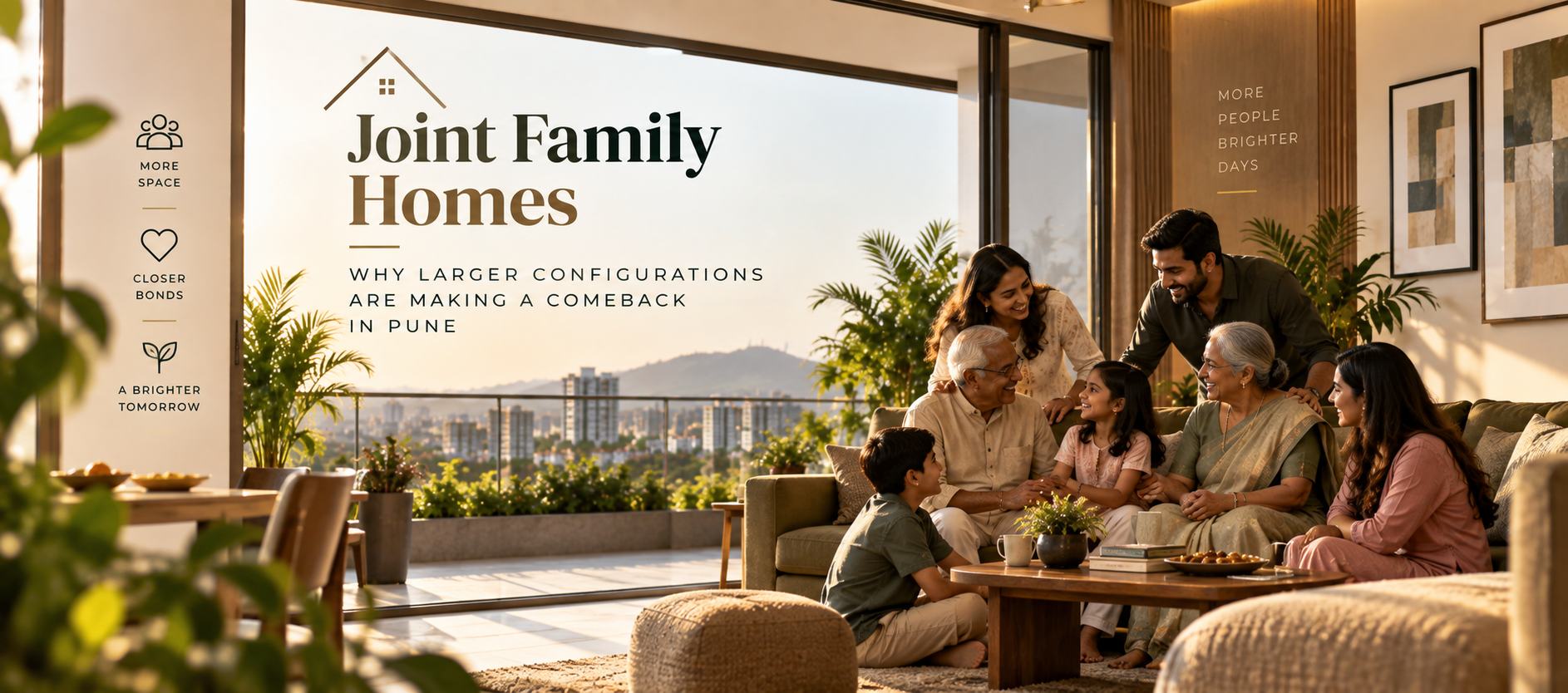
For much of the past two decades, India's real estate development followed the broader global trend toward smaller, nuclear-family-oriented housing — compact 1 and 2 BHK units built around the assumption of a couple, or a couple with one or two children, as the default household unit. In Pune, as in several other Indian cities, that assumption is now being quietly revisited, as demand for larger, joint-family-oriented configurations shows genuine signs of recovery.
What's Driving the Shift Back Toward Joint Family Living
Economic pragmatism. Rising property prices and the genuine cost of maintaining two separate households have made joint or extended family living a more financially sensible choice for many families — particularly for young couples early in their careers, or for aging parents who no longer wish to live independently but also don't want to fully give up their own space.
Childcare and eldercare practicality. Dual-income households, increasingly the norm rather than the exception, often rely on grandparents for childcare support — a joint or nearby-family living arrangement makes this considerably more practical than coordinating across separate residences. Similarly, as parents age, having them under the same roof (or very close by) simplifies caregiving considerably.
A cultural re-affirmation, not just a financial one. For many Indian families, joint family living was never truly abandoned by choice — it was simply constrained by available housing stock heavily skewed toward smaller configurations. As developers respond to demand, families who always preferred this arrangement are finding it more accessible again.
Post-pandemic reassessment of space and togetherness. The extended periods of lockdown and remote work during the pandemic led many families to genuinely reconsider the value of proximity to loved ones — a shift in priorities that has had a lasting effect on housing preferences well beyond the pandemic itself.
What Makes a Layout Genuinely Joint-Family-Friendly
Simply being large isn't enough — a genuinely well-designed joint family home addresses specific, practical needs that a standard large flat often overlooks.
Separate, private zones within a shared home. The best joint family layouts allow for genuine privacy — a bedroom with an attached bathroom for an elderly couple, for instance, positioned away from the noise and activity of common living areas, rather than simply adding more identical bedrooms along the same corridor.
Multiple, well-positioned bathrooms. A household of six or more sharing two bathrooms creates genuine daily friction. Look for configurations with at least one bathroom per two-to-three residents, thoughtfully positioned relative to bedrooms.
A functional, larger kitchen. Joint family cooking often means preparing food for more people, sometimes with multiple people cooking simultaneously (a daughter-in-law and mother-in-law, for instance) — a kitchen designed with adequate counter space and storage for this reality, rather than a compact nuclear-family kitchen, matters considerably.
Flexible common spaces. A living or dining area large enough to comfortably accommodate the full family together — for meals, for evening time together, for hosting guests — is a defining feature of a home genuinely built for joint family life, as opposed to one that simply stacks bedrooms together.
Balcony or outdoor space accessible to multiple rooms. Shared outdoor space that multiple family members — an elderly parent who enjoys morning sun, children who need play space — can access independently adds genuine daily value.
What to Ask Developers Directly
If you're specifically seeking a joint-family-oriented home, don't assume a generic "large 3 or 4 BHK" listing automatically meets your needs. Ask directly:
- Is there a bedroom with an attached bathroom specifically suited for elderly parents, positioned away from noisier common areas?
- How many bathrooms does the configuration include, and how are they positioned relative to the bedrooms?
- What's the actual kitchen size and layout, and does it support multiple people cooking simultaneously?
- Is there a genuinely usable common living or dining space, or does the layout simply prioritize bedroom count over shared space quality?
Considering Adjacent, Rather Than Shared, Units
For some families, the ideal solution isn't a single large joint family flat, but two adjacent or nearby units — offering both proximity and genuine independence. Some housing societies, particularly larger developments and townships, make this easier by offering multiple configurations within the same complex, allowing extended family members to live minutes apart rather than under one roof, while still enjoying shared community amenities and daily proximity.
A Financial Perspective
From a purely financial standpoint, joint family living — whether in one large unit or adjacent smaller ones — often makes considerable sense: shared maintenance costs, shared utility expenses, and in many cases, better overall use of household income that would otherwise be split across two separate rents or mortgages. For families weighing this option primarily on financial grounds, it's worth running the actual numbers comparing a joint arrangement against maintaining two fully separate households.
The Bottom Line
Joint family living in Pune is experiencing a genuine, demand-driven resurgence — not a nostalgic throwback, but a practical response to economic realities, caregiving needs, and a renewed cultural appreciation for extended family proximity. If this arrangement suits your family, look specifically for layouts designed with joint living in mind — genuine private zones, adequate bathrooms, and functional shared spaces — rather than assuming any large-format flat will automatically serve the purpose.