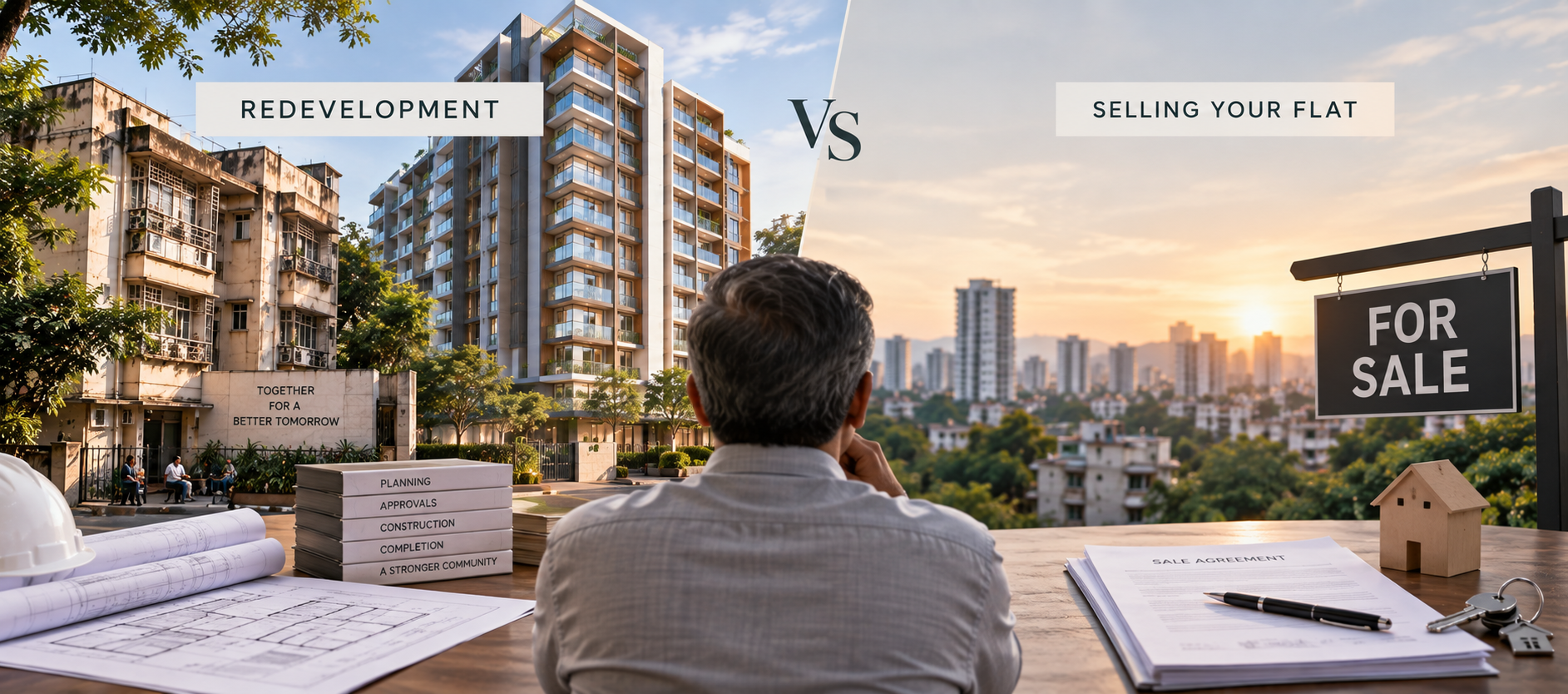
When a building starts showing its age — cracking plaster, outdated wiring, insufficient parking, a structural audit flagging concerns — owners eventually face a real, consequential decision: push for society redevelopment, or simply sell up and move on with life elsewhere. Both paths are entirely valid choices. The right one depends heavily on your specific financial priorities, timeline, and emotional attachment to your current home and neighborhood. This article walks through both sides in detail.
The Case for Selling
The Advantages
Immediate liquidity. You receive your money now, in full, without waiting years for a construction process to complete. For owners with pressing near-term financial needs — funding a child's education, medical expenses, or simply wanting to redeploy capital into a different opportunity — this immediacy has real value that shouldn't be dismissed.
No dependency on a developer's execution. You're not exposed to the risk of a developer's financial instability, construction delays, or disputes with other society members during a long redevelopment process. Once the sale closes, your involvement ends — clean and complete.
Freedom to relocate anywhere. Selling frees you to choose any locality in the city, or beyond, rather than remaining tied to your existing building's specific location — which matters if your life circumstances (job location, children's schooling, family needs) have shifted since you originally bought the flat.
The Disadvantages
Aging buildings often sell at a real discount. Buyers routinely factor in a building's age, remaining structural lifespan, and the likelihood of the building needing its own redevelopment eventually — even when the underlying location remains highly desirable. This means you may be leaving meaningful value on the table relative to the location's true market potential.
You forgo the option of upgraded space at no incremental cost. A redeveloped flat in the same location, delivered with significantly more carpet area and modern amenities, is often a stronger long-term asset than what an aging building can realistically fetch on the open resale market today.
Transaction costs add up. Brokerage fees, capital gains tax (unless reinvested under applicable exemptions), and the cost of purchasing a replacement property elsewhere — including that property's own stamp duty and registration charges — all meaningfully reduce your net proceeds from a sale.
Timing risk. Selling into a soft market, or under time pressure, can mean accepting a lower price than the property might command under better conditions — a risk redevelopment, once agreed, largely removes from the equation for individual members.
The Case for Redevelopment
The Advantages
A larger, modern home in the same location, at no incremental cost. Typically 25-35% more carpet area, delivered without any construction cost borne by members — the developer absorbs this expense in exchange for the right to build and sell additional units on the same plot.
Significant property value appreciation. A redeveloped building in an established, desirable locality commands materially higher resale and rental value than the old structure did — often substantially outperforming what the same capital could have achieved through alternative investments over a comparable multi-year period.
No relocation required, beyond the temporary construction period. You retain your neighborhood, school district, established community relationships, and daily routines — a genuinely underappreciated benefit, particularly for families with school-age children or elderly residents deeply rooted in the local community.
The developer bears construction risk and cost, not you. Beyond the temporary displacement rent, members aren't exposed to construction cost overruns, material price fluctuations, or contractor issues — these risks sit with the developer.
The Disadvantages
It takes time. Redevelopment timelines typically run two to four years from formal agreement to final handover — sometimes longer if complications arise. For owners with an urgent need for liquidity or a firm relocation timeline, this duration may simply be incompatible with their circumstances.
You need reliable temporary accommodation during construction. While this is funded through displacement rent payments from the developer, it still requires members to manage the logistics of a temporary move — packing, storage, adjusting to a different neighborhood temporarily, and eventually moving again once the new building is ready.
Outcome depends heavily on the developer's execution. A well-managed redevelopment process is genuinely smooth for residents; a poorly managed one — with construction delays, communication breakdowns, or financial strain on the developer — can be a source of significant, prolonged stress for the entire society.
Not every member may want to stay. In a redevelopment scenario, individual members generally can't opt out and sell independently once the society has committed collectively — meaning the decision requires a level of consensus that a purely individual sale doesn't.
A Simple Framework for Deciding
Ask yourself these three questions honestly:
1. Do I need liquidity now, or can I comfortably wait two to four years for a better long-term asset? If you have an immediate, pressing financial need, redevelopment's timeline may simply not align with your circumstances — selling becomes the more practical choice, even if it means leaving some value on the table.
2. Is my attachment to this specific neighborhood — and my life circumstances tied to it — strong enough to justify staying through a multi-year construction process? For long-time residents deeply embedded in the local community, this attachment often carries real, if hard-to-quantify, value. For those already planning to relocate for other reasons (a job change, downsizing, moving closer to family), that attachment may be weaker, tilting the decision toward selling.
3. Does my society have access to a financially credible, experienced redevelopment builder — and has the committee done genuine due diligence on that developer? This is, in many ways, the deciding factor. A well-chosen redevelopment partner substantially de-risks the entire process; a poorly chosen one can turn a theoretically beneficial decision into a genuinely stressful multi-year ordeal.
What the Numbers Generally Suggest
Purely on the financial mathematics, redevelopment tends to deliver stronger long-term value for members who can afford to wait — the combination of additional "free" carpet area and the property value uplift from modern construction in an already-desirable location typically outperforms what selling an aging building and reinvesting elsewhere would achieve, especially once transaction costs on both the sale and a replacement purchase are factored in.
That said, this financial advantage is conditional on competent execution. A redevelopment that faces years of delays, disputes, or a developer who becomes financially unable to complete the project erodes — and can even reverse — this theoretical advantage. This is precisely why the developer selection process, covered in detail elsewhere, deserves at least as much rigor as the underlying decision to redevelop at all.
The Deciding Factor Is Usually the Developer, Not the Decision Itself
For societies genuinely weighing redevelopment against selling, the single biggest variable in whether redevelopment turns out well isn't the decision itself — it's the developer's track record, financial stability, and transparency throughout the process. A financially sound, experienced, communicative redevelopment builder — one willing to document commitments clearly and answer hard questions directly — makes redevelopment a genuinely strong choice for most societies with the patience to see it through. Choosing that partner carefully is, in practice, the decision that matters most.