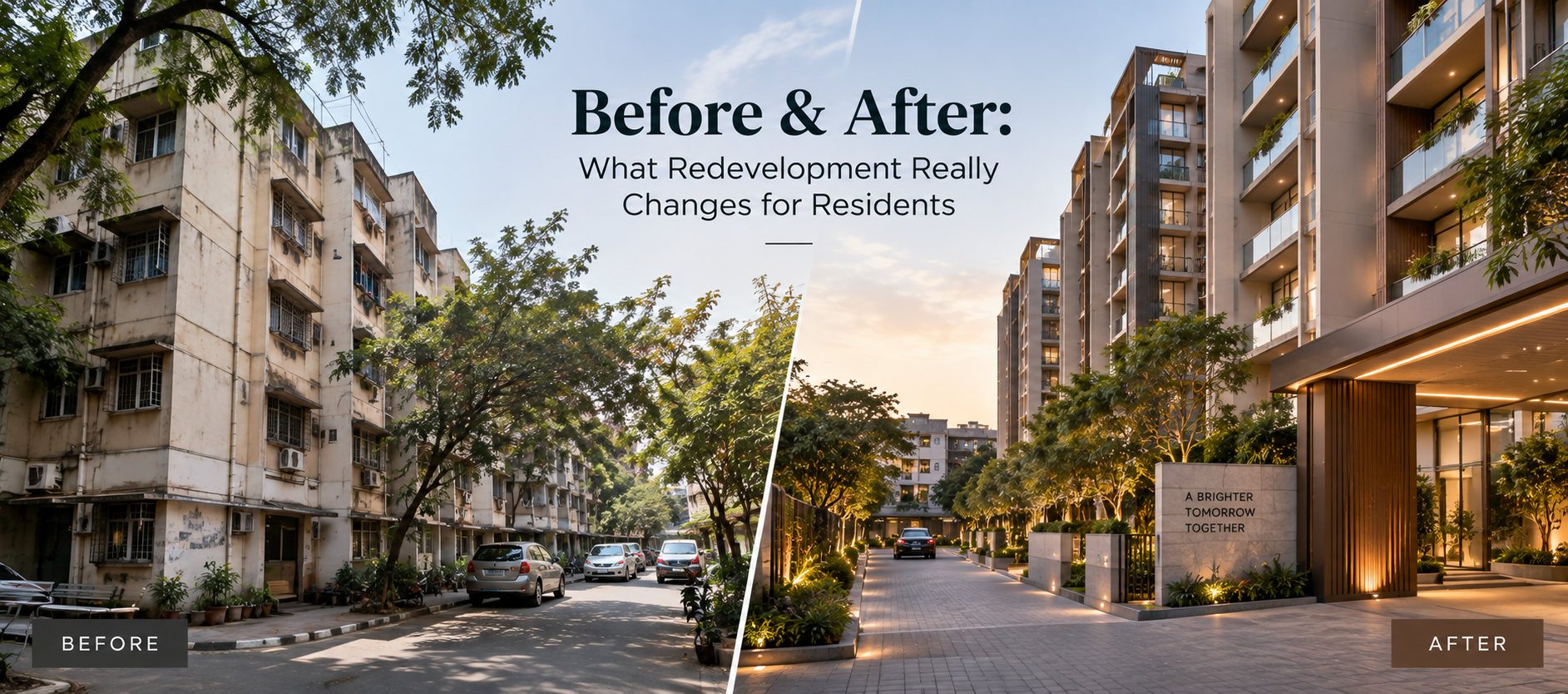
It's easy to talk about redevelopment in the abstract — "modern building," "better amenities" — but what does it actually change for the people living through it? Here's a realistic before-and-after comparison.
Carpet Area
Before: Older societies were typically built to older space standards, with smaller room sizes and less efficient layouts.
After: Members generally receive a meaningful increase in carpet area — often 25-35% more than their original flat — as part of the redevelopment agreement, since modern construction techniques allow for more efficient use of the same plot.
Structural Safety
Before: Buildings constructed 25-30+ years ago were built to the seismic and structural codes of their time, which have since been significantly upgraded.
After: New construction complies with current structural and seismic safety standards — a meaningful, if invisible, upgrade that matters most in the event of an actual emergency.
Parking
Before: Many older societies were built before car ownership became as common as it is today, leading to chronic parking shortages.
After: Modern redevelopment plans typically include dedicated covered or basement parking, designed around today's higher vehicle ownership per household.
Amenities
Before: Older buildings rarely included lifts in low-rise structures, dedicated security systems, or shared recreational spaces.
After: Redeveloped buildings commonly include elevators, CCTV and security systems, and in larger projects, shared amenity spaces like gardens or clubhouses.
Property Value
Before: Aging buildings in otherwise well-located areas often underperform on resale value relative to their location, simply because of the building's condition.
After: A redeveloped building typically sees a substantial jump in market value, since it now combines an established, desirable location with modern construction — often the single biggest financial benefit of the entire process for members.
The Emotional Side Nobody Talks About Enough
Beyond the physical changes, redevelopment lets residents stay rooted in the neighborhood, school district, and community they've built their lives around — without the disruption of relocating to an entirely new part of the city. That continuity is, for many families, just as valuable as the upgraded square footage.
What This Means If You're Considering It
If your society is weighing redevelopment, it helps to walk through this before-and-after picture concretely with any developer you're evaluating — asking them to specify exactly what changes for your specific building, not just what's true in general.