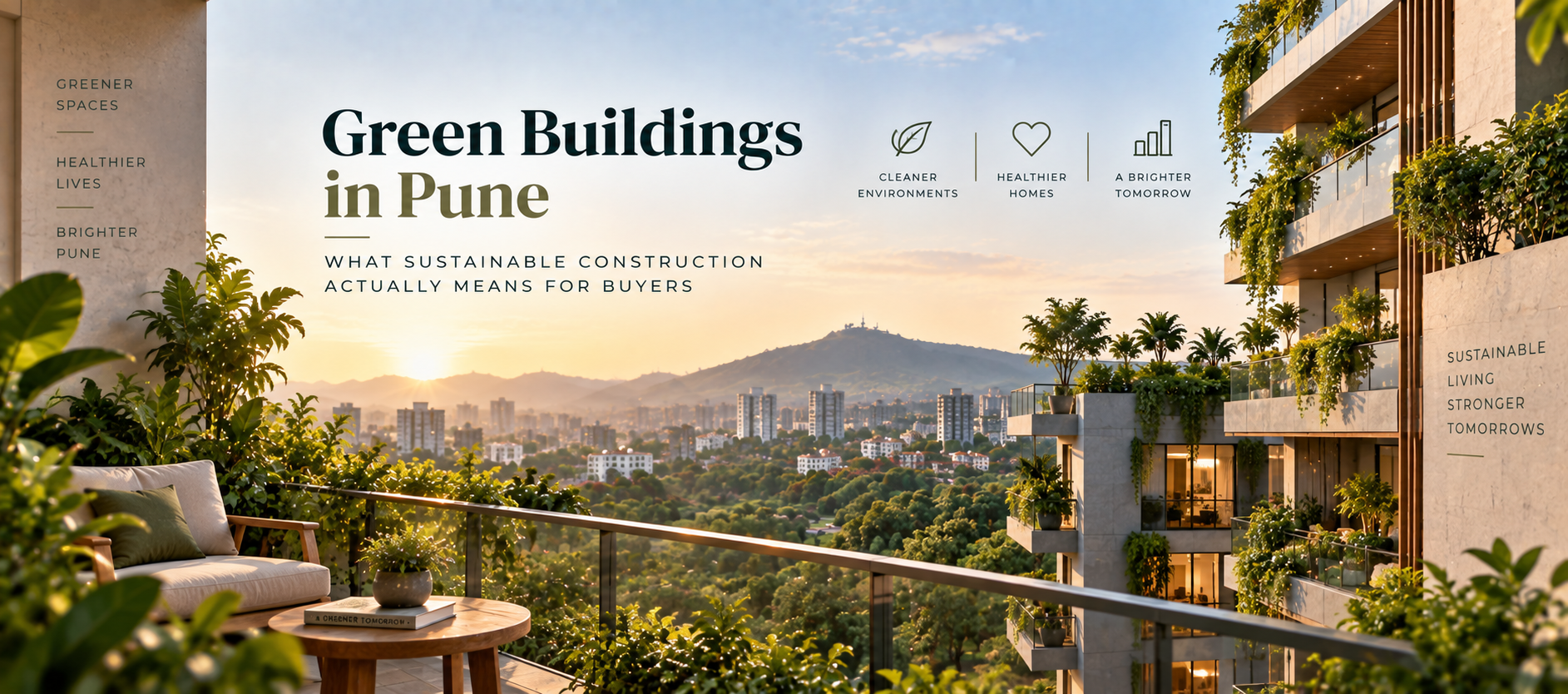
"Eco-friendly," "sustainable," "green" — these words appear on real estate marketing material with such frequency that they've started to lose meaning. Some of it reflects genuine, thoughtful construction practices; a fair amount of it is marketing language attached to fairly standard buildings. This guide walks through what actually constitutes a green building, how to verify genuine claims, and why it matters practically for buyers in Pune.
What "Green Building" Actually Means
A genuinely green or sustainable building incorporates design and construction choices specifically intended to reduce environmental impact and resource consumption across its lifecycle — not just a few solar panels or a rooftop garden used for marketing photography, but systematic choices affecting energy use, water consumption, waste management, and material sourcing.
The Certifications Worth Knowing About
In India, a few recognized green building certification systems provide a genuine, third-party-verified benchmark, rather than relying on a developer's own marketing claims:
IGBC (Indian Green Building Council). India's most widely recognized green building rating system, covering residential, commercial, and other building categories, with certification levels ranging from Certified to Platinum based on the extent of sustainable features incorporated.
GRIHA (Green Rating for Integrated Habitat Assessment). A rating system developed specifically for Indian climatic and construction conditions, jointly administered by TERI and the Ministry of New and Renewable Energy, assessing buildings across categories like site planning, energy efficiency, water conservation, and waste management.
LEED India. An adaptation of the internationally recognized LEED (Leadership in Energy and Environmental Design) certification, tailored for Indian building and climate conditions.
Why certification matters: a building actually pursuing one of these certifications has undergone independent assessment against specific, measurable criteria — a meaningfully different standard than a developer simply describing a project as "green" in marketing copy without any third-party verification.
What Genuinely Sustainable Features Look Like in Practice
Energy efficiency measures. This includes building orientation designed to maximize natural light and minimize heat gain, energy-efficient lighting (LED fixtures as standard rather than optional upgrades), and in more advanced projects, solar power installations for common area electricity needs.
Water conservation systems. Rainwater harvesting systems (genuinely functional, not just installed and unused), water-efficient fixtures throughout the building, and in some developments, greywater recycling systems for landscaping and non-potable uses.
Waste management infrastructure. Segregated waste collection systems, and in more comprehensive developments, on-site composting facilities for organic waste.
Sustainable material sourcing. Use of materials with lower environmental impact in their production — though this is admittedly harder for a buyer to independently verify without technical expertise, making third-party certification particularly valuable for this specific claim.
Landscaping and green cover. Genuine green spaces — not just decorative planters, but meaningful tree cover and landscaped areas that contribute to cooling the immediate environment and improving air quality around the building.
How to Separate Genuine Sustainability from Marketing Language
Ask for the specific certification, if claimed. If a developer describes a project as "green" or "sustainable," ask directly whether it holds, or is pursuing, IGBC, GRIHA, or LEED certification — and at what level. A developer unable to answer this specifically, despite using sustainability language prominently in marketing, is likely engaged in more marketing than substance.
Ask about functioning systems, not just installed ones. Rainwater harvesting systems and solar installations are sometimes installed to meet regulatory requirements or marketing needs but poorly maintained or effectively non-functional in practice. Ask specifically how these systems are maintained and whether they're actually operational.
Look at the numbers, where available. Genuine sustainable buildings often can quantify their benefits — expected reduction in common area electricity costs, water savings percentages, or specific energy efficiency ratings — rather than relying purely on qualitative, feel-good language.
Why This Matters Practically for Buyers, Beyond Environmental Values
Lower ongoing costs. Genuinely energy- and water-efficient buildings translate into real, measurable savings on electricity and water bills over time — a practical financial benefit, not just an environmental one.
Better indoor comfort. Thoughtful building orientation and natural light optimization genuinely improve day-to-day living comfort, reducing dependence on artificial lighting and cooling.
Regulatory and future-proofing considerations. As environmental regulations in India continue to tighten over time, buildings already meeting higher sustainability standards are better positioned to remain compliant without costly retrofits, and may hold better long-term value as buyer preferences increasingly favor genuinely sustainable construction.
Growing buyer demand. As awareness of these issues grows, particularly among younger, more environmentally conscious buyers, genuinely certified green buildings may see stronger long-term demand and resale value compared to conventional construction, all else being equal.
A Word of Balanced Caution
It's worth being realistic: not every sustainability feature commands a price premium that fully justifies itself on pure cost-benefit terms in the short term, and not every buyer needs to prioritize green certification above other, more immediately impactful factors like location and developer credibility. The goal of this guide isn't to suggest every buyer must insist on IGBC Platinum certification — it's to help buyers distinguish between genuine, verifiable sustainable construction and marketing language that doesn't hold up to specific questions.
The Bottom Line
Green building claims are increasingly common in Pune's real estate marketing, and increasingly worth scrutinizing carefully rather than accepting at face value. If sustainability genuinely matters to your decision — whether for environmental values, long-term cost savings, or future-proofing — ask for specific certifications, functioning systems (not just installed ones), and quantifiable benefits, rather than relying on the word "green" appearing prominently in a brochure.