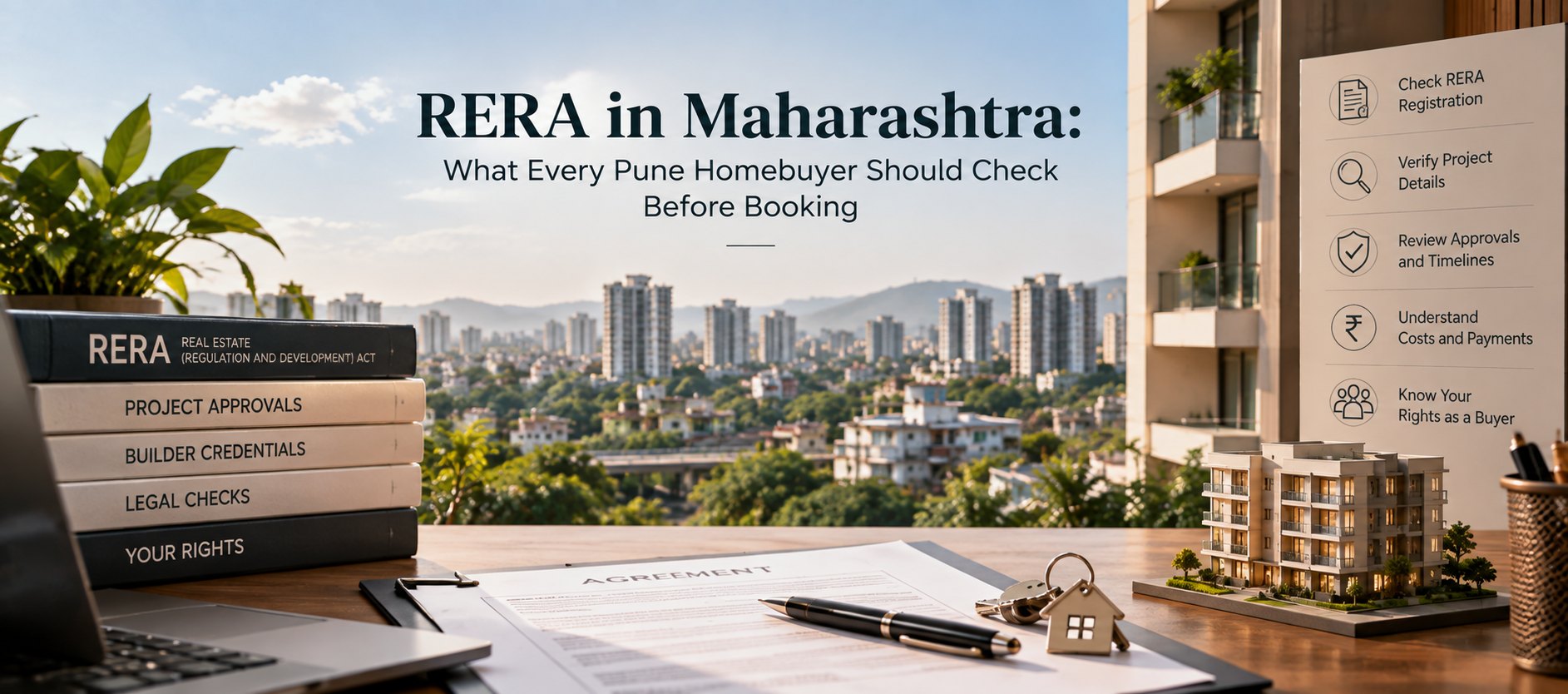
RERA — the Real Estate Regulatory Authority — has genuinely reshaped how real estate transactions work in Maharashtra since its introduction. Before RERA, buyers routinely faced vague promises, undisclosed project changes, indefinite delays with no recourse, and murky fund utilization where money collected for one project could quietly be diverted elsewhere. RERA was designed specifically to close these gaps. But here's the catch: it only protects you if you actually understand it and use it — simply hearing "RERA registered" mentioned in a sales pitch isn't the same as doing your own verification.
What RERA Actually Requires of Developers
Under the Maharashtra Real Estate Regulatory Authority (MahaRERA), developers of projects above a certain threshold are legally required to meet several specific obligations:
Mandatory registration before any marketing. A developer must register the project with MahaRERA before advertising, marketing, booking, or selling any units. This isn't optional or something that can be done "later" — it's a legal prerequisite to any sales activity.
Escrow account requirements. Developers must deposit 70% of amounts collected from buyers into a dedicated escrow account, to be used exclusively for that specific project's construction and land costs. This was one of RERA's most significant reforms, directly addressing the historical problem of developers using one project's buyer funds to complete a different, unrelated project — a practice that contributed to many high-profile project delays and failures before RERA existed.
Accurate, updated disclosure. Developers must provide accurate project information on the MahaRERA portal — including approved layouts, construction timelines, and land title details — and update this information as the project progresses.
Possession date accountability. Developers must deliver possession by the date declared at registration, or pay compensation to buyers for delays, calculated per the terms specified under RERA regulations.
What You Should Actually Check Before Booking
1. The Project's MahaRERA Registration Number
Every legitimate project above the threshold has one, and it should be clearly and prominently stated on all marketing material — brochures, websites, advertisements. If a developer is vague, evasive, or slow to provide this number when asked directly, treat that as an immediate red flag.
2. Cross-Verify on the Official MahaRERA Portal
This is the step most buyers skip, and it's genuinely the most important one. Take the registration number the developer provides and look it up directly on the official MahaRERA website. Don't rely solely on the developer's word — verify independently. This takes a few minutes and can reveal discrepancies between what's being marketed to you and what's officially on record, including the declared possession date, approved layouts, and any complaints or extension requests filed against the project.
3. Approved Layout and Floor Plans
Verify that what's actually registered with MahaRERA matches what's being marketed and sold to you. Discrepancies here — even seemingly minor ones — can indicate either unauthorized changes to the approved plan or, in more concerning cases, a project that hasn't received the approvals it claims to have.
4. Past Project Delivery History
MahaRERA's portal often shows extension requests filed by developers for their registered projects, which can be a genuinely useful indicator of a developer's historical track record with meeting stated timelines. A developer with a pattern of repeated extension requests across multiple projects warrants more caution than one with a clean delivery history.
5. Complaint History
Check whether any complaints have been filed against the developer or the specific project on the MahaRERA portal. While the presence of a complaint doesn't automatically disqualify a developer — disputes can arise even with generally reputable builders — a pattern of unresolved or numerous complaints is worth taking seriously.
Common Misconceptions About RERA That Buyers Should Understand
"RERA registration means the project is fully approved and completely risk-free." This is a significant misunderstanding. RERA registration confirms compliance with specific disclosure and escrow requirements — it does not independently verify construction quality, guarantee the developer's overall financial health beyond project-specific fund utilization, or eliminate all forms of risk. Your own due diligence — site visits, reference checks, reviewing the actual agreement terms — remains essential even for a fully RERA-compliant project.
"Only large projects need RERA registration." Most projects above the minimum threshold (broadly, projects covering more than 500 square meters or comprising more than 8 units) require registration, regardless of whether they feel "large" from a buyer's perspective. Don't assume a smaller project is exempt — always check.
"Once I've booked, RERA protects me automatically from any issue." RERA provides a regulatory framework and a formal complaint mechanism, but exercising your rights under it — filing a complaint for delays, for instance — still requires buyer action. It's not a passive shield; it's a tool you need to actively use if something goes wrong.
What to Do If You Spot a Problem
If your independent verification on the MahaRERA portal reveals a discrepancy — a mismatched registration number, an unregistered project being actively marketed, or details that don't align with what you've been told — raise it directly with the developer and request clarification in writing. If the response is unsatisfactory, this is a legitimate basis to reconsider the purchase entirely, or to file a formal query with MahaRERA before proceeding further.
A Simple Rule of Thumb for Every Pune Buyer
Before you pay any booking amount for a flat in Pune — regardless of how reputable the developer's brand appears, or how convincing the sales presentation was — look up the project's RERA number on the official MahaRERA portal yourself. It takes a few minutes and tells you considerably more about the project's actual regulatory standing than any brochure, sales pitch, or verbal assurance ever will. This single habit, more than almost anything else, is what separates informed buyers from those who discover problems only after their money is already committed.