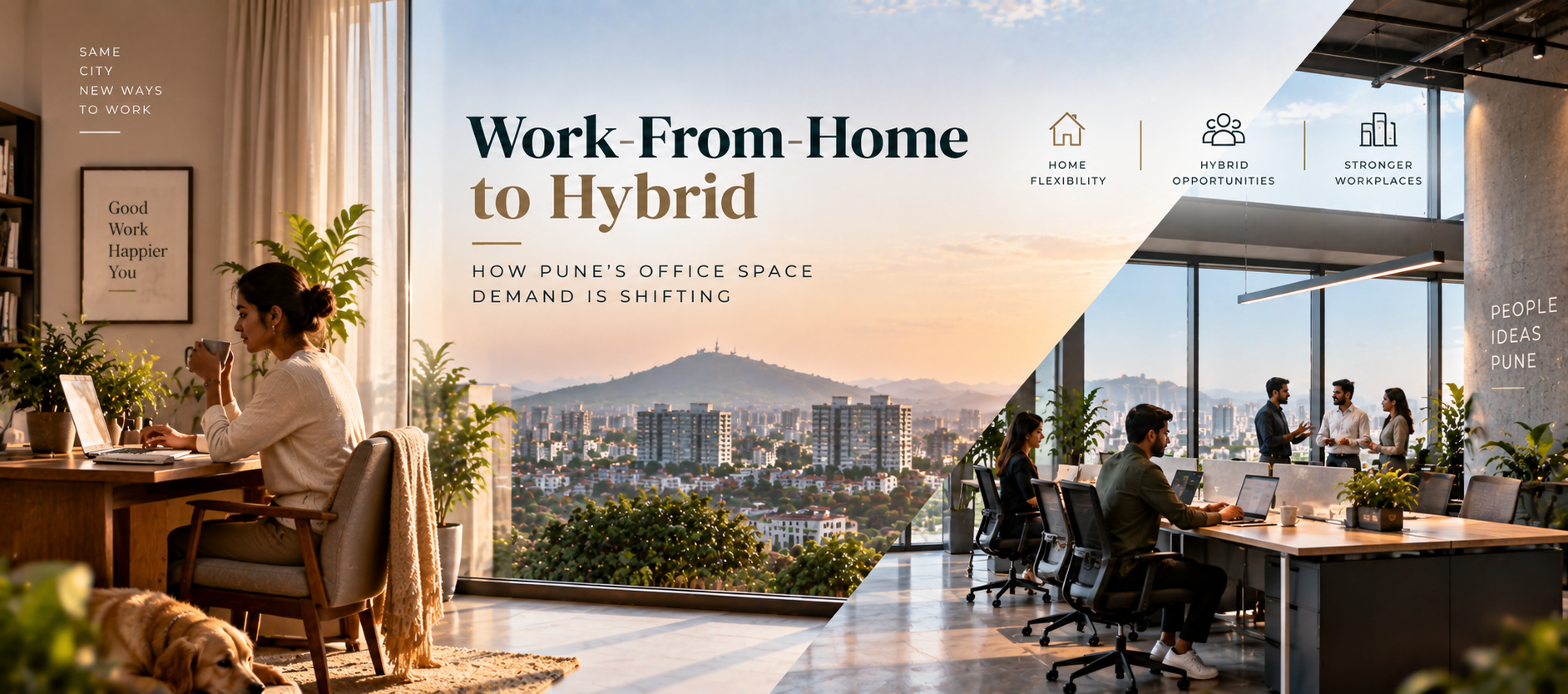
A few years ago, the conversation around office space in Pune — and every other major city — was dominated by a single, urgent question: is the traditional office dead? The answer, several years into the post-pandemic hybrid work era, has turned out to be more nuanced than either the "office is dead" or "everyone's coming back full-time" camps initially predicted. Here's what's actually shifted.
From Full Remote Back Toward Hybrid, Not Full Return
The initial pandemic-era shift to full remote work has, for most companies, settled into some form of hybrid arrangement — a mix of in-office and remote days, rather than a full return to five-day, in-office norms or a permanent shift to fully remote operations. This middle-ground outcome has specific, practical implications for how businesses think about office space.
What's Changed in How Businesses Use Office Space
Less space per employee, but not zero space. Many companies have reduced their total office footprint, since not every employee is present every day — but very few have eliminated physical office space entirely. The net effect has generally been a reduction in overall square footage demand per employee, rather than a collapse in total office space demand.
A shift toward flexible, collaborative layouts. Rather than rows of individual desks, many businesses are redesigning their office space around collaboration — meeting rooms, informal gathering spaces, and areas designed for the specific activities (team discussions, client meetings, focused collaborative work) that are harder to replicate remotely, while assuming that solo, heads-down work often happens at home.
Growing interest in flexible and co-working arrangements. Businesses uncertain about their exact future space needs, or wanting to avoid long-term lease commitments during a period of continued workplace evolution, have increasingly turned toward flexible co-working spaces or shorter-term lease structures rather than traditional long-term commercial leases.
Quality over quantity in office space decisions. With employees no longer required to be in the office out of pure necessity, businesses are more focused on making office space genuinely worth commuting for — better amenities, more thoughtful design, and locations that minimize commute friction — since a mediocre office in an inconvenient location now competes directly against the very real alternative of working from home.
What This Means for Pune's Commercial Real Estate Specifically
IT and tech-adjacent businesses have led this shift most visibly, given the sector's early and widespread adoption of remote and hybrid arrangements — meaning commercial spaces primarily serving this sector (parts of Hinjewadi, Kharadi's IT-driven inventory) have had to adapt most directly to changing space requirements.
Sectors less suited to remote work have seen more stable office space demand. Legal practices, healthcare providers, educational institutions, and many client-facing professional services genuinely require physical presence for much of their work — meaning commercial demand in areas serving these sectors (central, civic-adjacent locations like Shivajinagar, for instance) has remained comparatively more stable through this transition.
Flexible, professionally managed commercial spaces have gained an edge. Commercial properties offering flexibility — smaller unit sizes, shorter lease terms, or configurations that can adapt to co-working or shared-office models — have generally fared better in this environment than large, rigid, long-term-lease-only commercial developments built around pre-pandemic assumptions.
Location quality matters more, not less. With businesses more selective about the office space they commit to, factors like connectivity, surrounding amenities, and overall environment quality have become more important differentiators — a mediocre space in a mediocre location has a harder time competing for tenants than it did when office presence was simply mandatory.
What This Means If You're a Commercial Property Investor or Business Owner
For investors: commercial properties in flexible, professionally managed formats — smaller unit configurations, mixed-use developments supporting multiple business types, and locations with genuine connectivity advantages — are likely to show more resilient demand than large, rigid, single-tenant-oriented commercial spaces built around older assumptions about office use.
For business owners evaluating office space: it's worth being deliberate about matching your actual space needs (informed by your specific hybrid policy, not generic assumptions) to your commercial lease decision, rather than defaulting to pre-pandemic space planning norms that may no longer reflect how your team actually works.
Sectors Bucking the "Less Space" Trend
Interestingly, not every sector has reduced its office footprint. Client-facing professional services — legal practices, financial advisory firms, healthcare providers — have in many cases maintained or even expanded physical space, since their core value proposition depends on in-person client interaction in a way that's much harder to replicate remotely. This is part of why flexible commercial developments supporting a genuinely diverse tenant mix — spanning both hybrid-friendly and physically-dependent business types — tend to show more resilient overall demand than developments built around a single sector's assumptions.
Looking Ahead
The office space conversation in Pune, as in most major Indian and global cities, appears to be settling into a durable new normal rather than continuing to swing wildly between extremes. Businesses have largely worked out their preferred hybrid balance, and commercial real estate decisions are increasingly being made with this stabilized reality in mind — favoring flexibility, quality, and genuine connectivity over sheer square footage. For anyone evaluating commercial space in Pune today, understanding your specific business's actual space needs under its settled hybrid policy is a far more useful starting point than either pre-pandemic assumptions or early-pandemic predictions of the office's demise.